
Which skills do your sales reps need to master to be great at their job?
Asking questions. Listening for pain points. Problem solving. Handling objections. Enabling internal champions. Building relationships. Navigating procurement. Making promises they can keep. Nailing their closing sequence and the hand-off to Customer Success. That’s a lot—and it’s not all.
Most operations and enablement teams also ask their reps to memorize dozens (hundreds?) of processes and procedures across just as many tools. Think Salesforce, Outreach, Gong, Linkedin, and the countless others needed in the typical day in the life of a sales rep.
Software is the gateway to selling, but there are too many tools and processes to learn. And yet when sellers don’t perfectly adopt new processes—quickly, correctly, and easily—everyone loses.
The problem for sales reps
66% of sellers say they’re drowning in solutions designed to make them more productive.
And new research shows sales reps spend less than 30% of their time selling. Every workshop, e-learning module, and “quick” video designed to teach your reps how to operate all of these tools takes time away from their craft (and actual job 💀).
What are sellers doing, instead of learning about your product, customer, and competitors? Trying to memorize a truly overwhelming volume of SOPs.
The problem for sales operations and enablement
Some sales operations and enablement professionals spend so much time responding to repeat questions, fixing data quality issues, and re-training reps on processes, they might as well update their title to “CRM Support Specialist.”
“Eventually I did the math. In a 40-hour week, I was spending over 10 hours (more than a fourth of my time!) doing nothing but providing CRM support for our sales team. ”
-Camela Thompson, Founding Member at RevOps Rise
Once you’ve been sucked in, it’s hard to escape the gravity of tactical support. Soon, strategic work starts living in a galaxy far, far away.
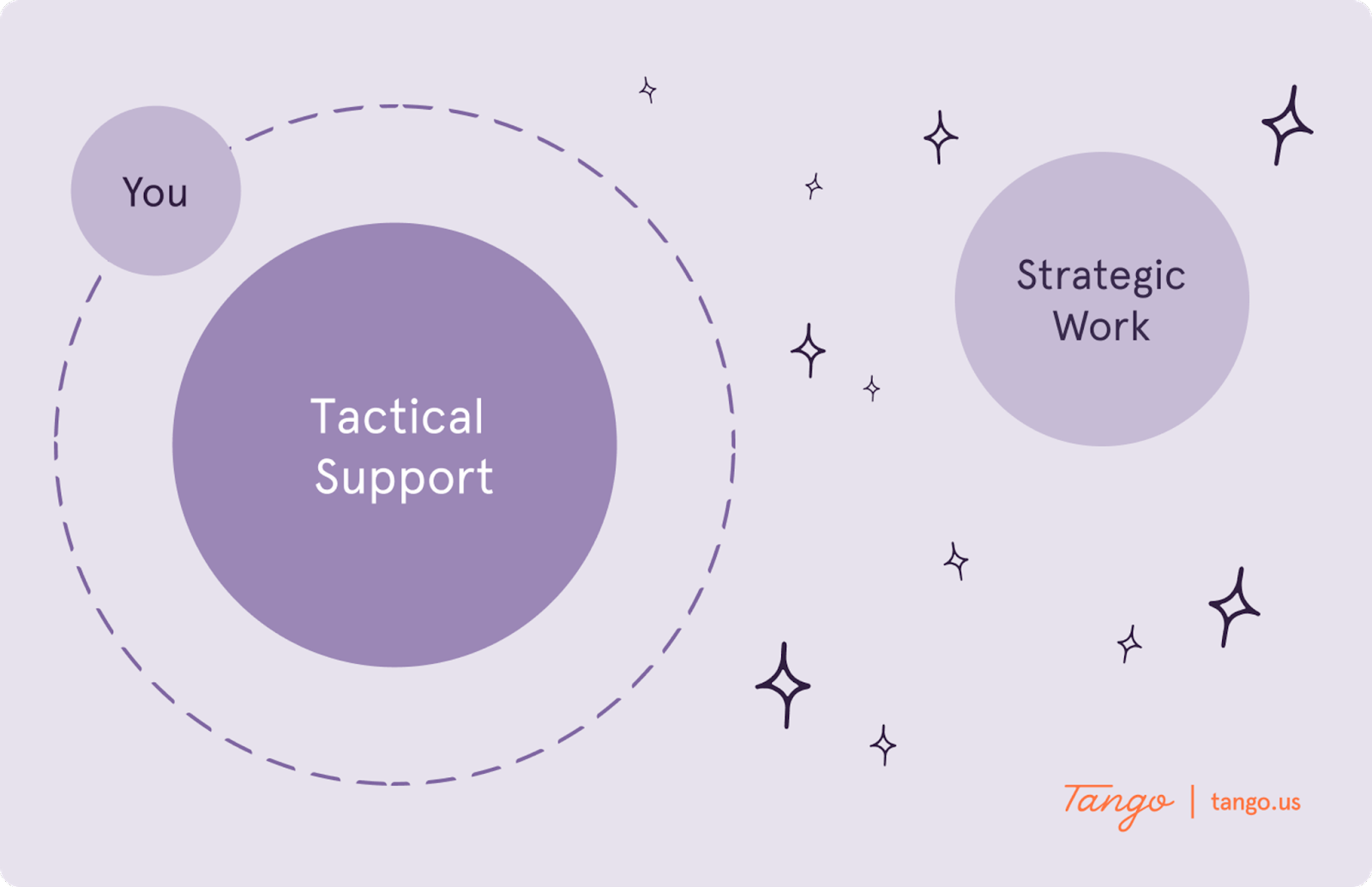
The existential crisis of knowing you need to do more meaningful work—without having the time or headspace to do it—is real. (And ongoing.)
Forget:
- Analyzing revenue program effectiveness
- Implementing KPIs to drive cross-functional alignment
- Offering accurate insights into pipeline and revenue forecasts
…or any of the other high-impact initiatives you were hired for. There’s no time left.
The evolution of software training for sales
We’ve tried to solve the headache of software process adoption in various ways over the years. While there’s a place for each of the methods below, none have successfully eliminated the biggest sources of friction.
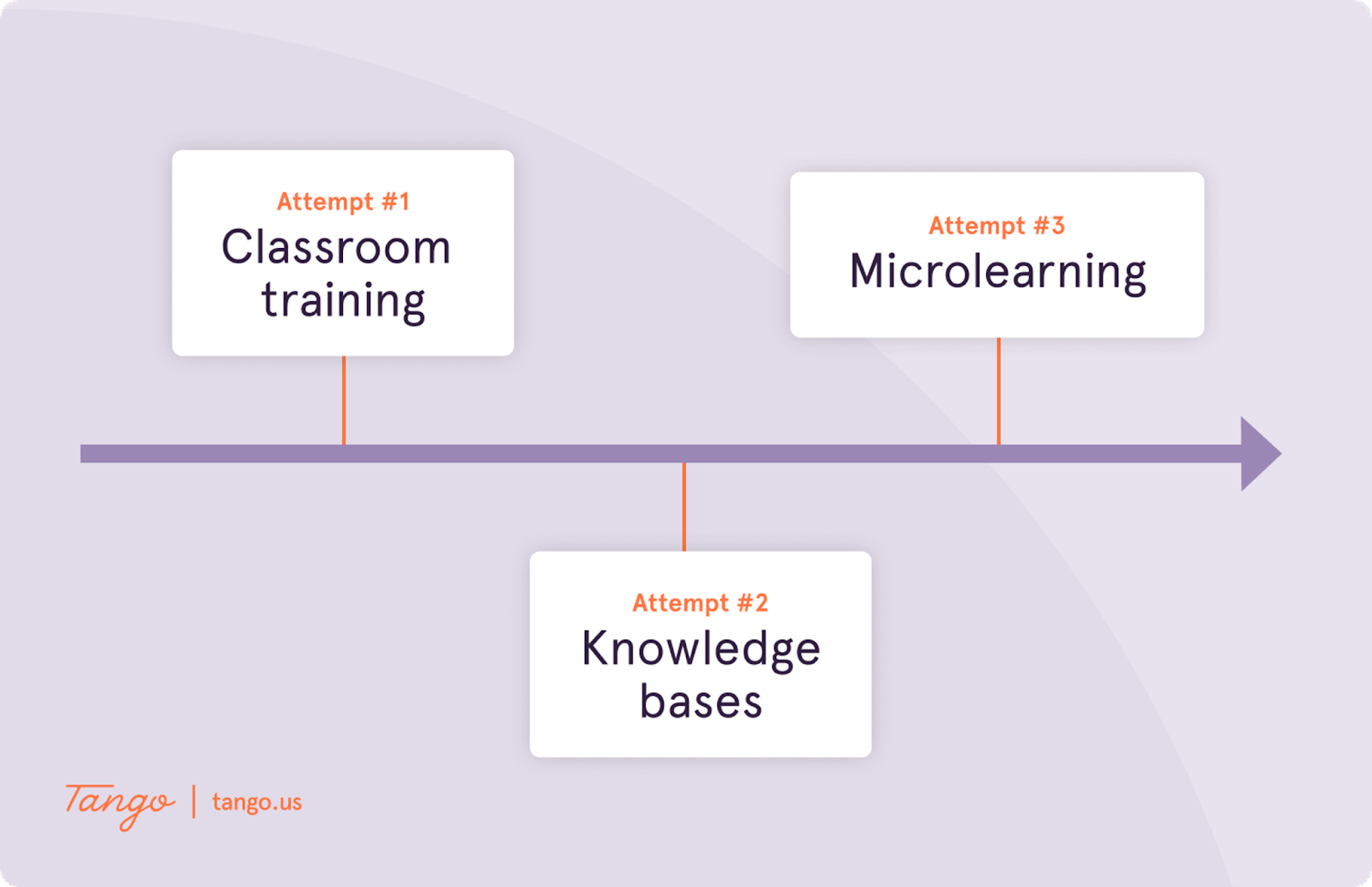
Attempt #1: Classroom training
First there was classroom training. Before we realized that pulling reps away from core selling activities to absorb (often extraneous) training wasn’t the best move, we used to:
- Host a mandatory meeting with too many PowerPoint slides
- Expect reps to memorize everything and recall it perfectly when the time came
- Pull them in again every month or two when the software invariably changed
What goes without saying? They weren’t paying attention, and they didn’t remember.
Attempt #2: Knowledge bases
The rise of the knowledge base solved five challenges of in-person software training:
- Fleeting information
- Short attention spans
- Small memory banks
- Nowhere to point sellers to if/when they got stuck
- No way to help anyone self-serve
But creating a supposed “single source of truth” for people to reference previously documented processes created a new set of problems.
If you asked Sales, they’d tell you knowledge base content was hard to find, digest, and/or trust. If you asked Operations and Enablement, they’d tell you it didn’t matter how helpful or accurate their SOPs were—sellers simply didn’t want to go looking for it. 🤷
Attempt #3: Microlearning
Microlearning, an approach delivered by Learning Management Systems, took enablement by storm after it became clear that sellers had 1) a very short window of tolerance for software training, and 2) even less patience for searching for answers in folders of resources.
By chunking key information into 10-15 minute videos and sending sellers an email a day, microtraining made incremental improvements. But in the end? The engagement stats still weren’t there.
Sellers quickly lost interest in:
- Context switching to watch long videos about questionably relevant topics
- Reading daily emails with how-to instructions that could rarely be applied in the moment
Why traditional software training sets sellers up for failure
Classroom training, knowledge bases, and microlearning are all examples of traditional software training. See also: well-intentioned strategies with weak results.
So what makes traditional software training fall down?
Flawed expectations
With traditional software training, we expect sales reps to:
- Memorize dozens of (constantly changing) procedures
- Train when it’s convenient for Operations and Enablement, not them
- Search multiple knowledge bases
- Read through walls of text and watch boring videos
…and then we wonder why sellers aren’t acting more engaged, answering their own questions, or taking advantage of every tool in their tech stack.
Accidental and/or blatant disregard for “ambivalent adopters”
When it comes to training humans, human psychology matters. And the fact is, people hate change and want their hands held. Sales reps included.
Some reps are more resistant than others. Instructional designer Brittany Arbuckle calls them “ambivalent adopters.” Read: anyone with doubtful, contradictory, or fearful feelings about new technology and processes.
Ambivalent adopters aren’t lazy or bad people. They care about their job and your company. They just aren’t that interested in learning new software. Or memorizing dozens of procedures in Salesforce, Outreach, and Gong. You won’t see them eagerly supporting anyone’s “culture of documentation,” leaning into self-service, or getting on board with rational solutions to their [seemingly irrational] concerns.
So what ARE ambivalent adopters interested in?
- Staying in their comfort zone and sidestepping change
- Suffering silently and avoiding feeling stupid
- Having their hand held if/when they do seek help
TL;DR? 👉🏿 Traditional software training doesn’t align with ambivalent adopters’ interests OR ease their fears.
The next chapter of software training for sales teams
So what comes after classroom training, knowledge bases, and microlearning? And what’s designed to reduce sales reps’ resistance to change and ongoing desire for hands-on support?
💡 Real-Time Enablement. Real-Time Enablement eliminates the need for reps to memorize software processes so they can focus on their craft.
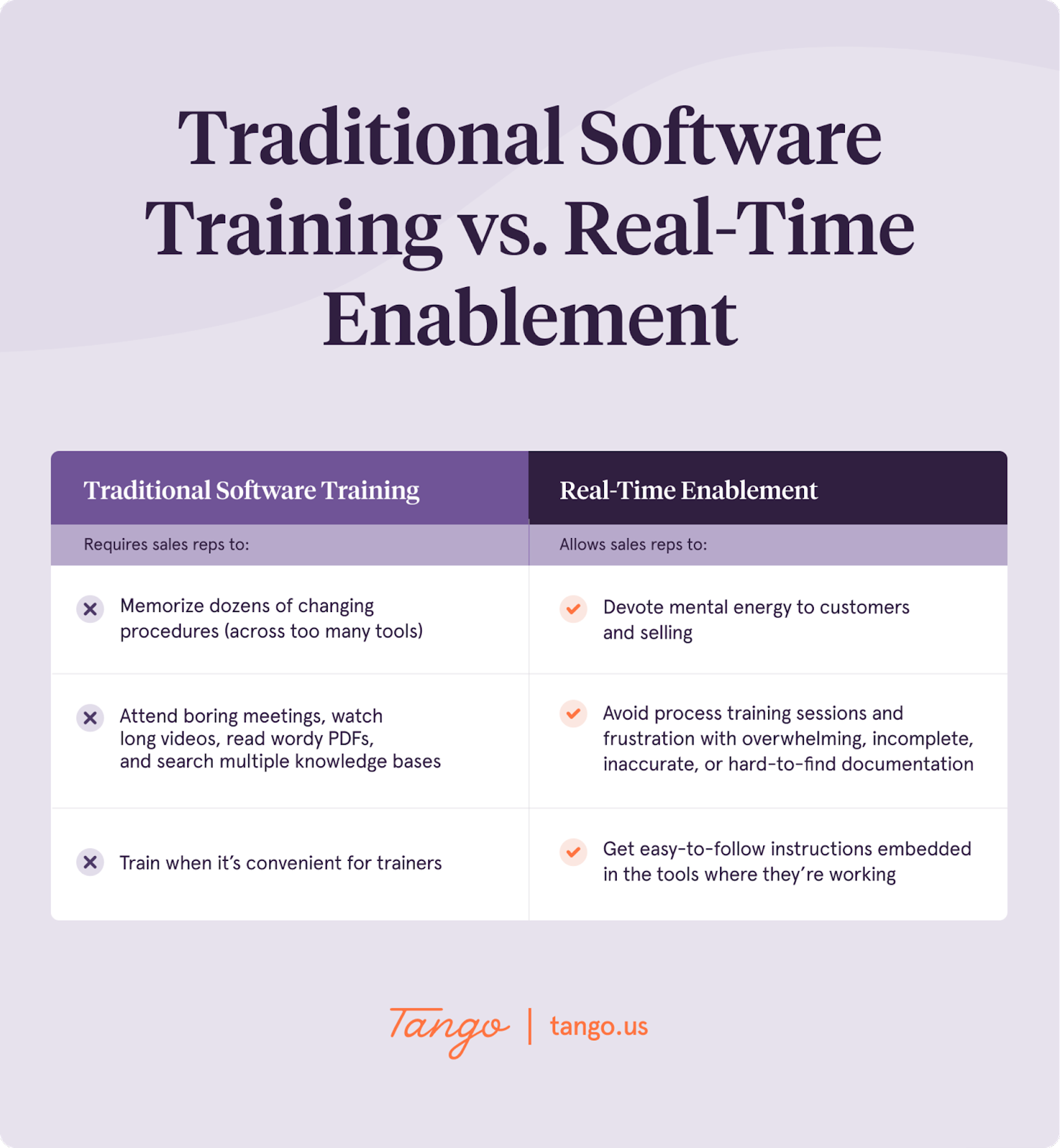
Wondering how sales reps can do their jobs without memorizing how their CRM and other tools work?
They have operations and enablement teams who 1) get them, and 2) do these three things. ⬇️
1. Embed instructions directly in the tools sellers use
What if you:
- Empathized with how annoying it’s been for reps to learn how to do stuff in software
- Stopped linking to long videos, outdated wikis, and winding chat threads
- Embedded the instructions to procedural FAQs inside of the software sellers already use
It’d be a lot easier to:
- Take advantage of reps’ willingness to learn in the heat of a real-world task
- Avoid the trap of good information presented at the wrong time
- Save time creating training destined to go in one ear and out the other
- Reduce the amount of searching and context switching required to get work done
- Create more capacity for everyone to do more meaningful work
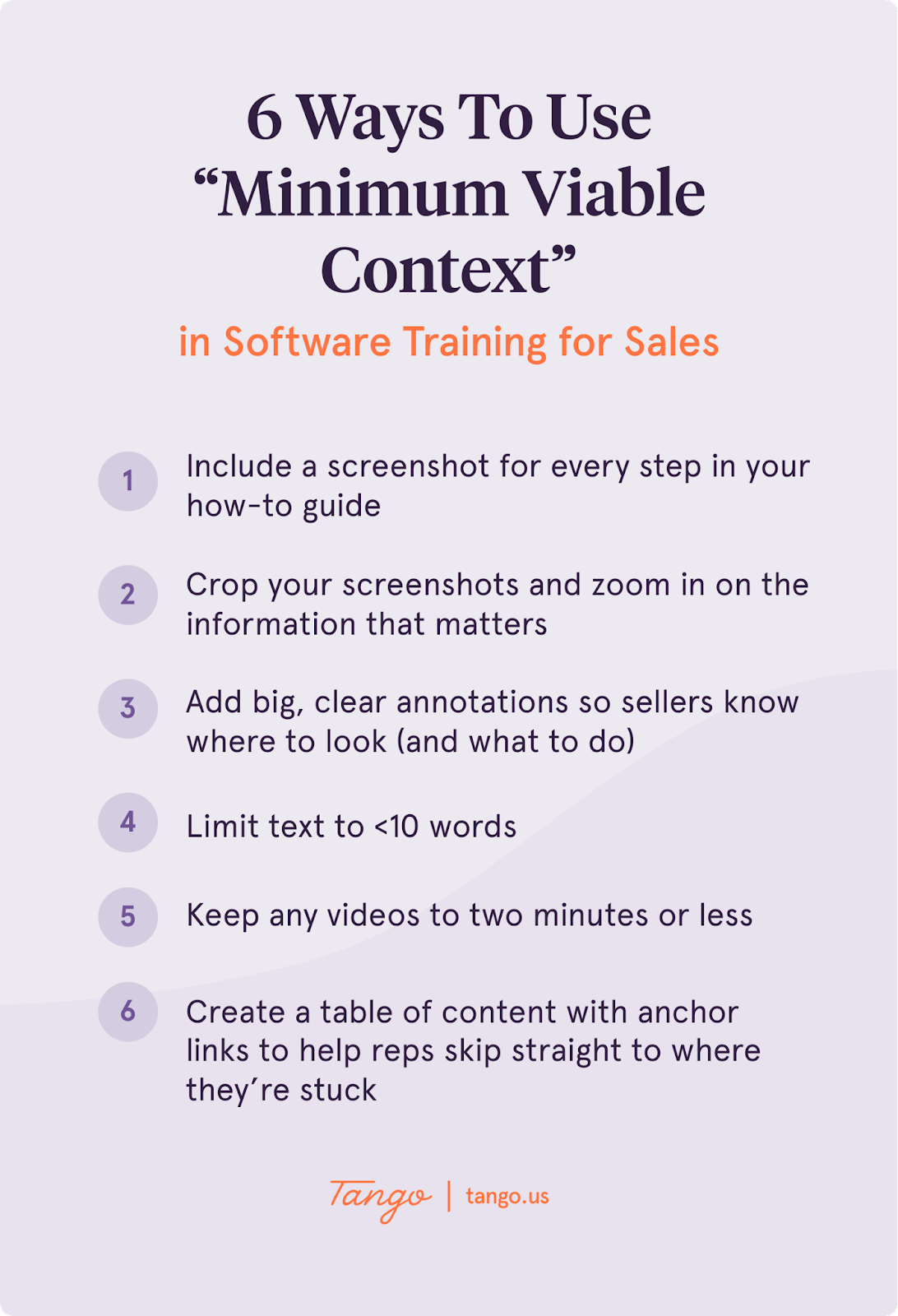
2. Use “minimum viable context” to make key sales processes easy enough to follow on autopilot
We surveyed ~400 people to learn what they dislike about software how-to guides, and what’d we find? There either isn’t enough context…or there’s too much. 😆
The most effective documentation:
- Helps sales reps zip through dozens of software procedures
- Saves energy for learning what matters—how to sell, compete, and win
- Strikes that balance between too much and too little information
We call this “minimum viable context” (or MVC) at Tango. It’s the Goldilocks Zone, where no one’s overwhelmed or asking 100 follow-up questions. Because everyone’s got (just) what they need.

Minimum viable context is great for when:
- Learning or memorizing a task won't help sales reps be any better at their jobs (read: 99% of software procedures)
- A process and/or software UI is changing regularly
- Sellers just need to know where to click
- The task only needs to be done every once in a while
3. Measure process adoption, not product usage
If you're in charge of rolling out new software, none of these things matter as much as you might think:
- When you complete your task checklist
- How many training sessions you led
- If people are active in the new tool
- How many questions and complaints you are/aren't fielding
Your boss—and your boss's boss—are under pressure to show return on investment on tech stack changes they championed. Want to help them prove the $$$ was worth it (and your enablement efforts are working)?
Stop measuring product usage and start measuring process adoption. 🌟
Knowing that sales reps are logging into a tool like Salesforce is nice. But that datapoint doesn’t:
- Tell you whether sellers are following your workflows step-by-step and completing them correctly 100% of the time
- Help you see where reps are getting stuck, adapt your documentation accordingly, and offer personalized help if needed
With insights about process adoption in hand, you can go beyond vanity metrics and answer the two main questions executives are likely to have about your project:
- Is our new software solving the business problem we set out to solve?
- Are we successfully enabling everyone on our team?
When you're able to prove that process is a proxy for a desired business outcome, it's easier to convince leadership that your project is a success—and ROI is well on the way.
What Real-Time Enablement looks like
If you’ve been nodding your head all along—while wondering what Real-Time Enablement tools actually look like—this clip is for you.
Here’s what Salesforce looks like to our sales team here at Tango. 👇
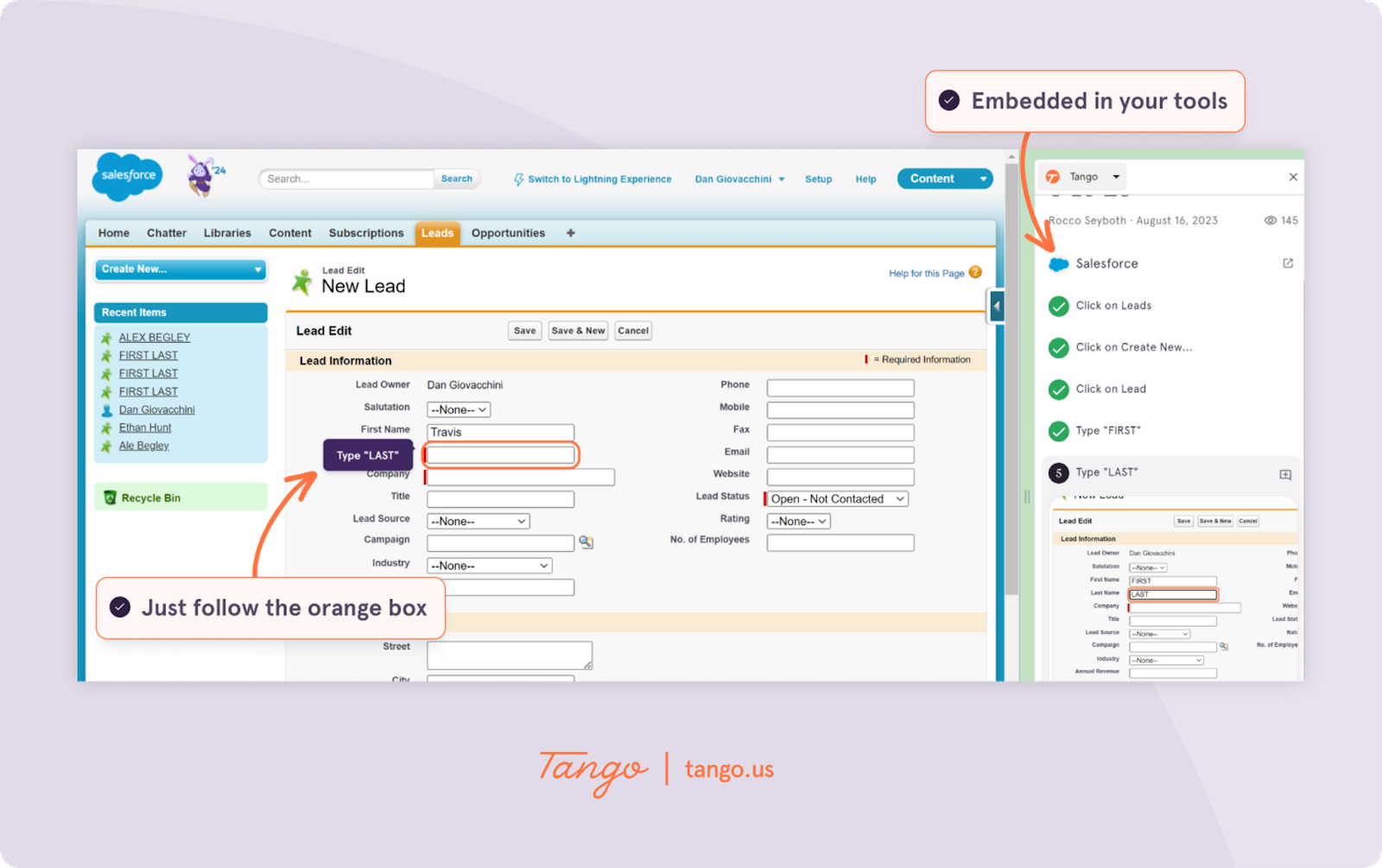
When there’s a new rep or a new process, all they need to do is open the software they’re trying to use, click the Tango icon, and browse the walkthrough options suggested from the Tango AI.
From there, a step-by-step guide pops up in their browser. Right next to what they’re doing (in Salesforce or any other tool)—so they don’t need to bounce between the task at hand and how-to instructions.
Then Tango does 99% of the heavy lifting. Reps just need to follow the orange box telling them which fields to click or fill out. The beauty lies in how brainless it is.
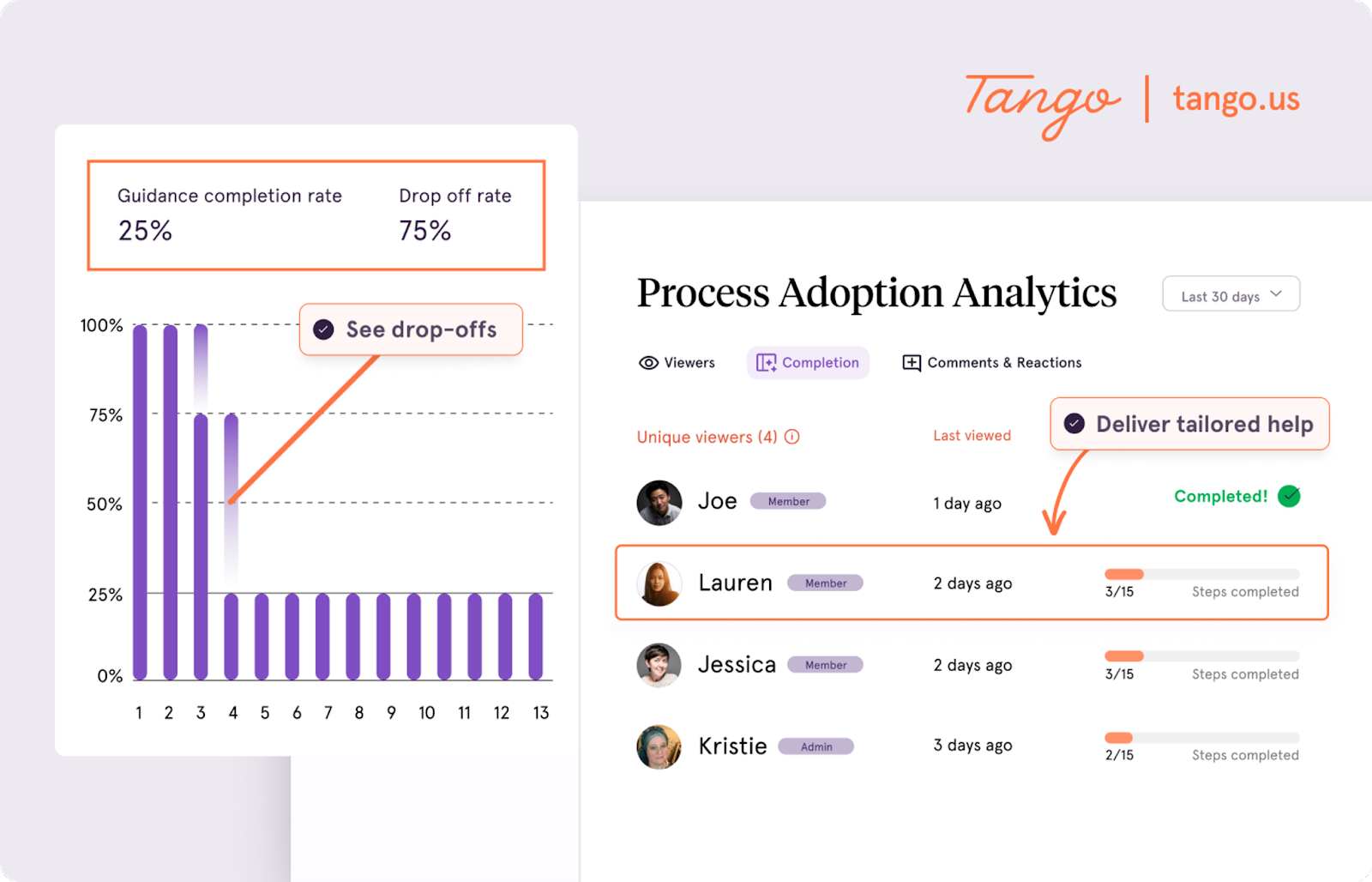
But the *real* magic lies in Tango’s dashboard for operations and enablement teams, which:
- Aggregates process adoption analytics at a team level
- Makes it easy to see which rep(s) fell off, where, at an individual level
- Measures process adoption, software ROI, and enablement efforts in no uncertain terms
What’s in it for sellers, enablers, and executives?
We opened this article by saying process adoption has a profound effect on sellers, operators, and executives. To come full circle: so do the benefits of Real-Time Enablement.
Real-Time Enablement for sellers
With a better alternative to traditional software training, sellers can spend more time developing customer, product, and sales expertise.
With Real-Time Enablement, sales reps can expect:
✅ More mental energy for the job they were hired to do
✅ Information and insights delivered in their exact moment of need
✅ Minimum viable context
✅ A lasting hiatus from memorizing software procedures
✅ A welcome relief from wordy documentation and long (likely outdated) videos
✅ A permanent vacation from weeding through disparate knowledge bases
Real-Time Enablement for operators
Remember the existential crisis re: strategic work vs. reactive requests?
With Real-Time Enablement, there’s a lot less pushing and pulling—and a lot more time for pursuing meaningful projects and solving big problems.
Real-Time Enablement for executives
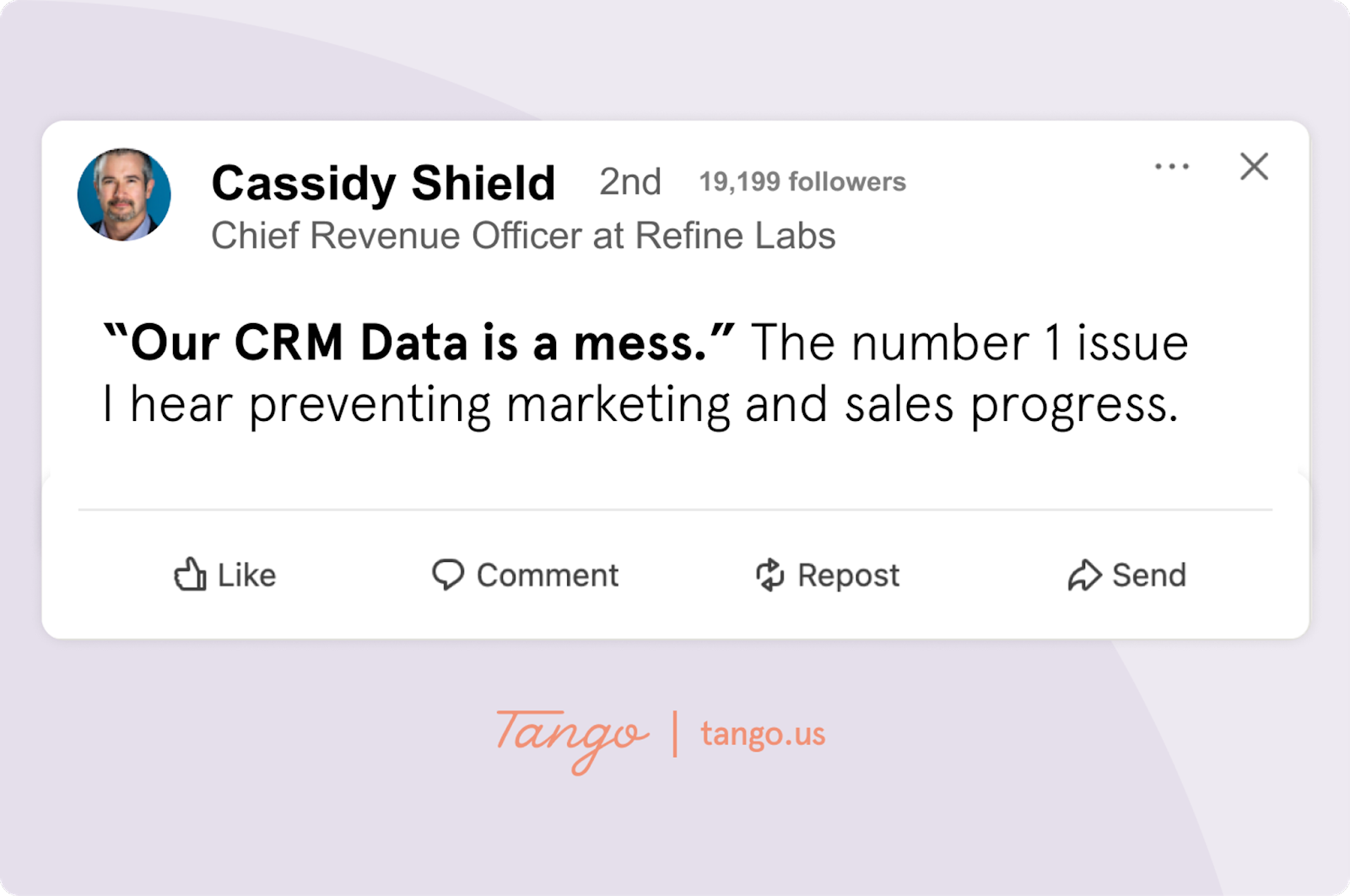
Your execs are looking for increased predictability. “Garbage in, garbage out” is all too true when it comes to sales tools.
Sales and operations expert Cassidy Shield doesn’t dance around the elephant in the room: people don’t trust their CRM data.
If you work backwards, what are the root causes of useless CRM data (and bad business decisions)?
- Incorrectly executed processes
- Manual data mistakes
- Inaccurate reports
If reps don't manage leads and opportunities correctly, it’s easy to lose trust in every dashboard, report, and forecast. And it’s hard to win that confidence back.
Real-Time Enablement helps you flip the script to gold in, gold out.
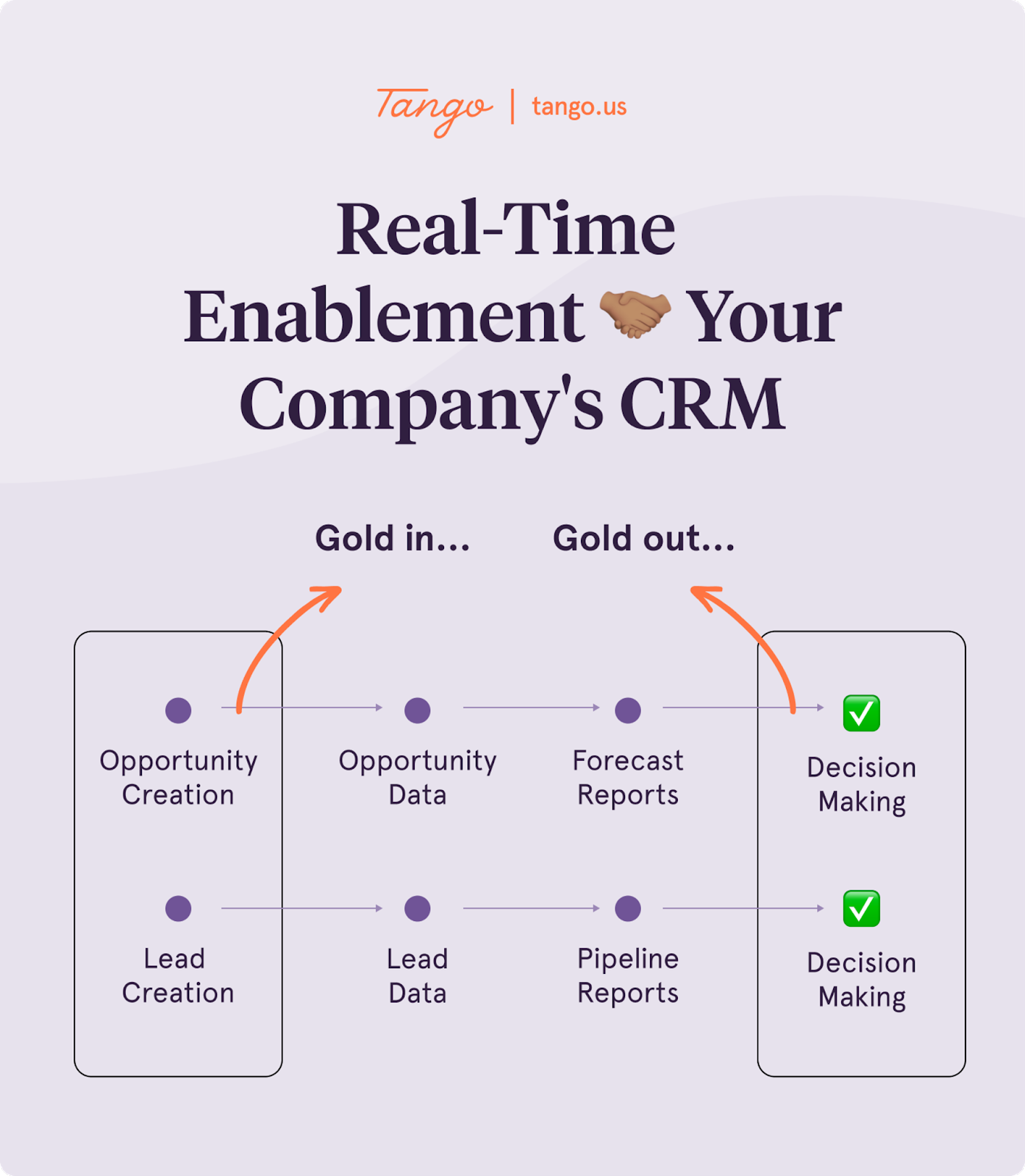
When Sales is successfully adopting software processes and RevOps is operating at a higher level, executives can expect:
- Fewer (manual) data entry mistakes
- More trustworthy pipelines, dashboards, and forecasts
- Tangible insights into process adoption
- A clearer understanding of software ROI
Have a big software rollout coming out and want to put Real-Time Enablement to the test?