
💡 What is knowledge retention?
Knowledge retention describes the successful transfer of information from short-term to long-term memory. Information can include everything from facts, concepts, and best practices to skills, procedures, and lessons learned over time.
Knowledge retention was big when you were younger. You had your multiplication tables (12 x 12= 144!), for math class. The periodic table, for chemistry. The 50 states and capitals, for US geography. Your home phone number, for emergencies.
But unless “Learning and Development” is in your job title today, information retention probably isn’t something you talk about a lot as an adult.
In this post, we’ll cover:
- Why knowledge retention (still) matters
- Common obstacles to information retention and how to overcome them
- The best way for managers to increase knowledge retention and encourage continuous learning
Why knowledge retention matters
Think back to your last core values brainstorm. (Either with your team or for your org at large.) Did some variation of “always be learning” land in the top five?
We talk a lot about learning at work. We look for “lifelong learners” when we hire. We encourage our teams to experiment and iterate. We advocate for making big bets based on information available and intuition. And we normalize failure, when there’s a swing and a miss. As long as we know more going out than we did going in, we’re doing what we were brought here to do.
We talk less about how “sticky” our lessons learned are. How much we remember—days, weeks, months, and years after the fact. But being able to recall and reapply knowledge quickly, easily, and accurately is critical. Especially for fast-moving teams.

1. Less knowledge debt
Knowledge debt is the accumulation of knowledge gaps—which have a tendency to multiply when learning retention is low.
2. More knowledge sharing (and institutional knowledge)
If you have higher knowledge retention across the board, what becomes easier, by default? Knowledge sharing. Which is a key component to ensure employees aren’t just doing the best to their ability—they’re doing the best to your organization’s ability.
Effective knowledge retention is a prerequisite to reaping the benefits of institutional knowledge—and using it as the competitive advantage it can/should be.
3. Fewer interruptions and far less context switching
When we can’t find the answers we need through self-service, we seek out help from peers. Which usually means multiple people on the team get pinged and asked to stop what they’re doing. And every time we bounce between tasks, our effectiveness decreases by 20–80%.
The TL;DR? Better learning retention at an individual level leads to less context switching for everyone.
4. Not as many (repetitive) errors
Everyone makes mistakes—but the volume of errors isn’t as high when people can quickly recollect 1) what went off the rails last time, and 2) how to avoid similar missteps in the future.
5. Increased efficiency and productivity
What’s *not* very efficient? Constantly having to search for answers. The more information everyone retains, the less time your team will spend getting stuck and the more time they’ll have to 1) improve their craft, and 2) get stuff done.
6. Better continuity and improved resilience
Without a solid knowledge retention strategy, what happens when someone gives their notice or changes roles within your org? Business as usual breaks down, fast.
Knowledge retention plays a significant role in succession planning, and keeps essential knowledge and valuable expertise from getting lost.
"Investing in knowledge retention is investing in the long-term success and resilience of your organization."
7. Faster innovation and more net new ideas
Businesses don’t only rely on readily accessible, collective expertise to maintain continuity and stability during times of rapid change. They also rely on intellectual capital to push the envelope and innovate faster than competitors.
To do that, you need everyone on your team to not only remember what they’ve learned, but also continually build on that knowledge.
"An organization's ability to retain knowledge is directly linked to its ability to innovate and stay ahead of the curve."
8 obstacles to knowledge retention (and how to overcome them)
Knowledge retention is intricately linked to about 100 other things. To name a few: Short and long-term memory. Adult learning principles. Documentation [dos and don'ts]. Knowledge acquisition. Knowledge transfer. Knowledge management. Knowledge sharing technology and tools.
If your team is struggling with knowledge retention, the root causes may spread far and wide. Scroll down to see what to look for (and how to fix what you find).
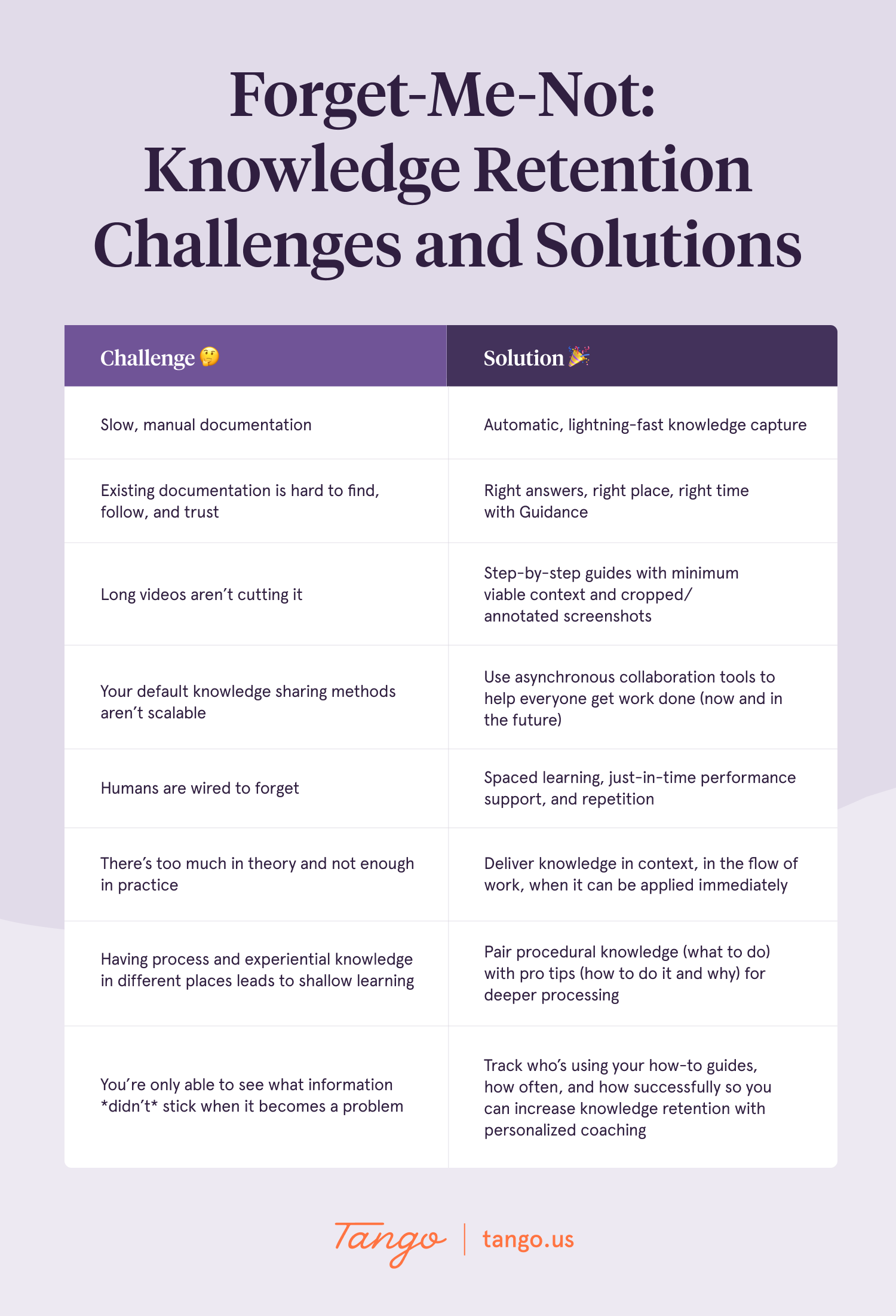
1. No one has time to document (especially complex processes).
The problem
Knowledge has to be captured before it can be retained, but documenting a single process can take hours. Especially if it’s complicated, with nuances and exceptions to the rule(s).
What this means:
- Documentation ends up on the “nice to have” list
- Insights that would benefit everyone stay trapped in the heads of a few star performers
- Documentation culture doesn’t take root—resulting in knowledge gaps, stale documentation, and learning and upskilling challenges
The solution
Introduce a tool to help your process experts capture automatically processes *while* they work—and show others what they know, in seconds.
With Tango, your top performers can document their steps on any website or software and create a beautiful, shareable how-to guide in just a few clicks. No matter how complex the process.
| Documentation before Tango 😑 | Documentation with Tango 😎 |
|---|---|
| Tedious and time-consuming | Instantaneous |
| A task on top of the task | Two birds with one scone |
| Walls of text and wonky visuals | Step-by-step instructions with perfectly formatted screenshots |
| A dreaded chore | A routine delight |
2. The documentation you do have is hard to find, follow, and trust.
The problem
Getting people to document (at all) is one thing. Getting people to document well is another.
You don’t need to do an audit to know your existing documentation is all over the place. And when your team *does* find content that would be relevant, it’s usually outdated, wordy, and difficult to consume.
What’s the result? Mental energy for meaningful work and knowledge retention goes towards:
- Searching for answers scattered across hard-to-use knowledge bases, learning management systems, and wikis
- Combing through walls of text to figure out what is and isn’t accurate (and is and isn’t necessary)
- Creating questions for coworkers to fill in gaps and get unstuck
The solution
Instead of sending people on a wild goose chase to find information needed to do their jobs—and asking your visual learners to weed through text-heavy documentation—deliver the right answers, in the right place, at the right time, in the right format.
When people don’t have to waste time and energy looking for knowledge, they can focus on applying (and remembering!) what they’re learning.
With Guidance, answers show up where and when they’re needed, with no search required. Interactive, on-screen walkthroughs show your team exactly what to do and where to click, and export options that stay up-to-date as you edit make it easy to keep all your how-to guides current.
.gif)
3. You think long videos are what the people want.
The problem
You know people’s eyes will glaze over at a 10-page PDF—but you think long videos are your best alternative.
Here’s what we found, when we surveyed people to see what they don’t like about training videos:
- “There’s too much fluff.”
- “I can’t skip straight to the specific step I need.”
- “It takes 10 minutes to go through a video for a task that should take a few seconds.”
Note: If you work with the people in charge of making said videos, you may also hear that videos typically 1) require special skills to make and maintain, and 2) can’t keep up with the rate of business change.
The solution
Trade long videos for step-by-step guides with minimum viable context and cropped/annotated screenshots.
People want just the right amount of context in documentation—not too much and not too little. And that’s where minimum viable context comes in.
ℹ️ What's minimum viable context (MVC)?
MVC presents information in a way that provides just enough context for users to complete a task quickly and efficiently—without overwhelming them with unnecessary details.
By prioritizing efficiency and simplicity, you can use MVC to reduce cognitive load, improve knowledge retention, and help your team be more productive.
What do people want to see with your succinct instructions? Screenshots. Specifically, cropped and annotated screenshots.
With Tango, you can automatically crop, zoom, and annotate every screenshot, so there’s no mystery about what to do next and no extra information to wade through on the way.
4. Your default sharing knowledge methods aren’t scalable.
The problem
People aren’t retaining knowledge because knowledge isn’t being shared in ways that make it easy to preserve.
If you’re up for a little self-reflection:
- How many of your meetings are synchronous, and how often do you designate someone to capture/circulate takeaways?
- How many times a week do you agree to hop on a call to “share your screen real quick” and show someone how to do something? How often do you explain the same thing multiple times, to multiple team members?
- How long does it take you to refocus after being interrupted and stopping to answer an FAQ?
👀 Survey Says
According to a 2023 study by Tango, people like screen sharing because it’s an effective way to get personalized help from an expert.
But those same people admit it’s inefficient and takes them out of the flow of work.
Synchronous meetings and screen shares are ad hoc, fleeting, and forgettable. And neither one is conducive to deep work blocks, knowledge sharing at scale, or long-term knowledge retention.
The solution
Use synchronous meetings as they’re intended (to connect with co-workers) and use asynchronous collaboration tools to help everyone get sh*t done (now and in the future).
With Tango, you can streamline knowledge transfer and offer all the things people love about synchronous work, without any of the drawbacks.
Benefits to get your team on board:
- No more waiting for someone to be available when you’re blocked
- Curated insights from subject matter experts—without needing to pick anyone’s brain
- Better way to recall answers and replicate processes (without needing to ask for a redo 🤦♀️)
5. You’ve forgotten about the forgetting curve.
The problem
We’re wired to forget.
Some stats for you:
- After one hour, we retain only half of the information presented to us
- After one day, we forget more than 70% of everything we’ve learned
- After a week, we forget 90% of the information delivered through traditional training
Even on our best day, our short-term memory can only hold about seven items at once. We all have two things working against us:
| Information Decay 🤷🏿♂️ | Information Disuse ↪️ |
|---|---|
| The gradual loss of information in short-term memory over time (when we don’t actively work to transfer it to long-term memory) | Our brain’s neverending replacement of knowledge that isn’t used regularly (in favor of information that’s more important or relevant) |
The “forgetting curve” shows how learned information fades over time. What do we know for sure? The steepest drop in memory happens quickly after learning, so revisiting newly acquired knowledge is important, and sooner > later.
The solution
Whether you’re onboarding a new team member or helping someone upskill or reskill, lean into spaced learning, just-in-time performance support, and repetition.
Taking in a ton of information in one sitting—especially when it can’t be applied—is the kiss of death for knowledge retention. But when learning is spaced out and repeatedly delivered in the time of need, you can help your team fight information decay/disuse and remember more.
💡 Tango Tip
To increase your team's knowledge retention, try breaking down complex standard operating procedures into multiple how-to guides and sharing them as they're needed (vs. all at once).
6. There’s too much in theory and not enough in practice.
The problem
In your world, “real” training includes instructor-led courses, workshops, seminars, and sessions—and not much else. It seems like people are going through the motions and checking off a box vs. actually learning.
Formal training has a time, place, and topic. But when it comes to learning preferences, it’s hard to ignore the 94% of employees who prefer microlearning on the job.
Why is the majority unimpressed with traditional, typically more theoretical training?
- “It’s information overload.”
- “A lot of it doesn’t apply to what I do, in my job.”
- “Some stuff may be useful, but it’s usually delivered way before or way after I need it.”
No matter how good the seminar or how engaging the workshop, it’s tough to remember the fine print on a slide shown six weeks ago. 💀
The solution
Make it easier to learn on the job by delivering knowledge in context, in the flow of work. And make it harder to absorb information passively, without active engagement.
If you’re interested in increasing knowledge retention and thoughtful participation, you should be equally interested in learning by doing.
With Tango, you can deliver the answers people need asynchronously, in their exact moment of need. When they’re seconds away from being able to apply that newfound knowledge in a real-life situation (vs. in a sandbox or fake scenario). Which makes them infinitely more likely to remember it. 🙏🏿
💡 Tango Tip
When knowledge is visible, readily available, and always-on in the systems and tools that your team uses daily, it's a lot easier to bridge the gap between learning and doing.
7. Process knowledge lives in one set of documentation and pro tips live in another.
The problem
To retain knowledge for longer periods of time, our brains need to understand what, how, *and* why. But process knowledge usually gets stored separately from the experiential knowledge that takes people from good to great.
If you only explain “the what” behind a task, deep processing doesn’t have a chance to take place. Which makes it much harder for information to make it to long-term memory.
The solution
Store procedural knowledge (what to do) and pro tips (how to do it and why) side-by-side.
When you provide your team with “the how” and “the why,” they’re more likely to actively engage with your content and make connections to things they already know.
Those connections are key to 1) going beyond shallow processing, and 2) increasing successful knowledge retention.
With Tango, you can:
- Crowdsource best practices from the bottom up, from the people performing the task
- Curate and embed the best insights into your step-by-step guides
- Enable your team to go beyond surface-level learning and improve your documentation at large
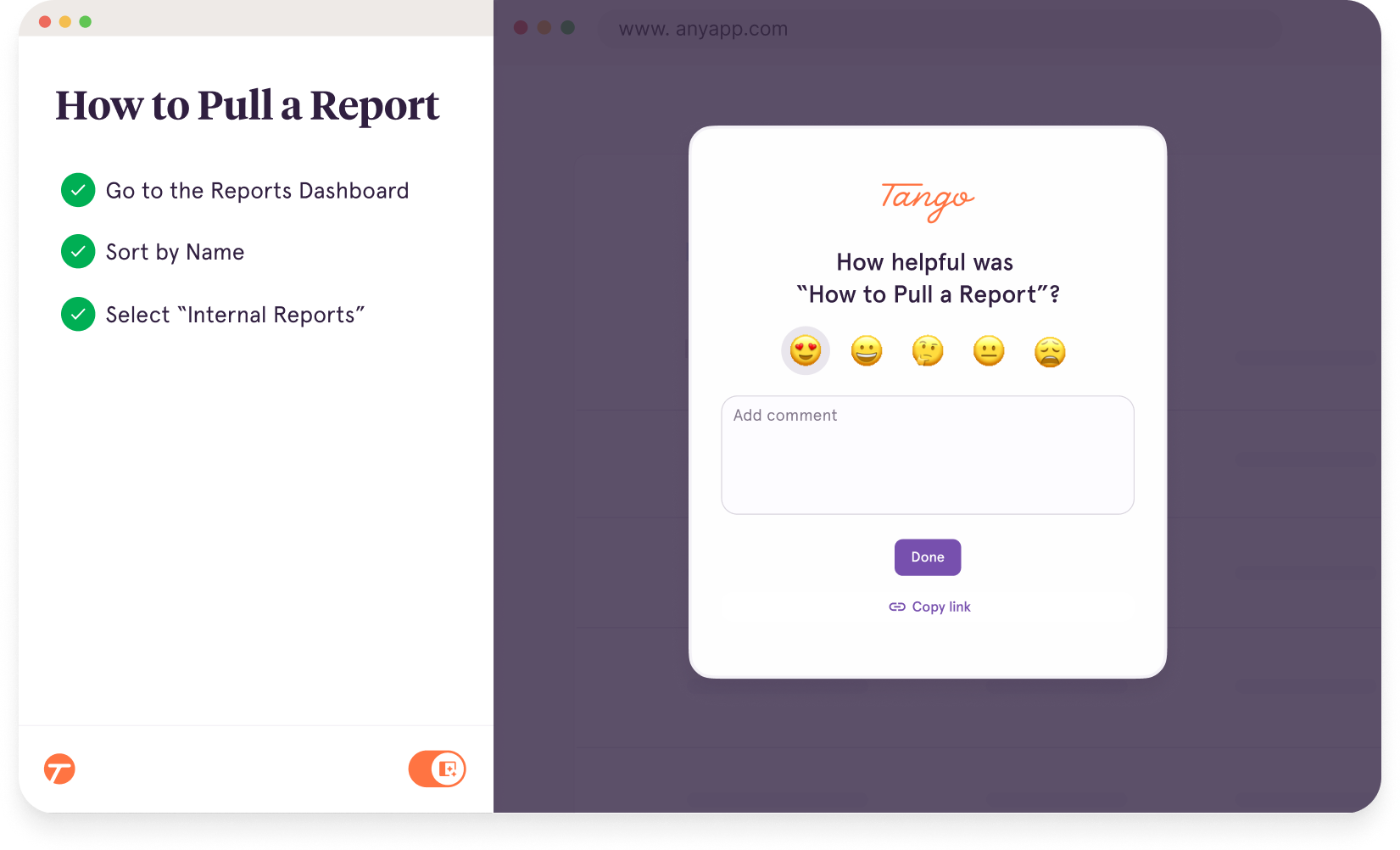
8. You have no way of knowing what did and didn’t stick.
The problem
You’re learning about what people didn’t retain too late—when it’s already become an issue.
If you only rely on word of mouth to understand what's landing and not, it’s hard to help people do their best work. Equally tricky? Improving your documentation over time.
The solution
Track who’s using your how-to guides, how often, and how successfully so you can increase proficiency with personalized coaching.
If you use Tango (👋, Guidance Analytics!), you can do all of the above while minimizing mistakes and making sure work gets done correctly.
You can skip the mini masterclass on how to avoid information overload, improve short term memory, and champion active learning (without jumping on a Zoom every other hour).
With Tango, you can break information up into more memorable chunks, deliver answers asynchronously (in the flow of work, when new knowledge can be applied immediately), and empower your team to serve themselves.
It’s never been easier to help people get sh*t done—and get better while they work.

The best way to ensure knowledge retention is to give people the knowledge they need, at the exact moment they can apply it in context, in a real world scenario.
On an individual level, knowledge retention is critical for personal development, professional growth, and continuous learning. It helps people build upon their existing knowledge, make informed decisions, and solve problems effectively.
On a company level, knowledge retention is essential because it promotes continuity, organizational learning, and employee development. The more companies value and invest in knowledge retention, the more equipped they will be to increase operational excellence and leverage institutional knowledge as a competitive advantage.
To improve knowledge retention means to enhance the ability of individuals or organizations to retain and remember information, skills, and experiences over time. It typically involves implementing strategies, techniques, and practices to optimize the acquisition, storage, retrieval, and application of knowledge. Common approaches include active learning, repetition and practice, personalization and contextualization, and collaborative learning.