Hey, I’m Dan—former B2B SaaS investor, Forbes 30 Under 30 honoree, and occasional pick-up hoops player. In 2020 I made the leap to start Tango with Ken and Brian, and I’ve never looked back. 🧡 Among the things I care most about are: tacos, software ROI, and helping people make an impact in their work.
"We know more than we can tell." Michael Polanyi, the chemist-turned-philosopher, wrote that in 1966 describing how experts carry knowledge they can't put into words. A master potter reads the clay by feel. A surgeon gauges tissue tension through their hands. So often, the knowing runs deeper than language.
Companies work the same way. Your best account manager handles escalations through 6 years of pattern recognition she's never written down. Your IT admin provisions new hires by memory, skipping 3 steps in the official runbook because those steps broke 2 years ago and nobody updated the doc.
And so goes the looming predicament facing organizations looking to use AI. Experts have struggled for centuries to pass on knowledge. Yet the need now is as great as ever. How can we teach ready and waiting AI Agents?
AI: A Context-Driven System
Maybe you haven't yet tried to run an agent yourself. But if you have, you've realized by now that AI needs a lot of help to actually do any of your work. Try to hand something meaningful to an AI agent and it's going nowhere. The agent has no feel, no intuition, no scar tissue from 6 years of things going wrong. It doesn't have instincts. But it's not an intelligence problem at all. It's a preparation one. The agent has whatever you load into its context window. And for most organizations, that window has been close to empty.
Toyota figured this out for their factories decades ago. Before they automated anything, every worker had to document and understand the manual process first. And sure enough, it was powerful. A 1995 study of Toyota and Honda found their core advantage over American competitors came down to one thing: they were better at turning tacit knowledge into documentation that could be handed off. The principle holds for AI. You can't automate what you haven't articulated.
The major AI companies knew this before anyone even tried using a coding agent or a ChatGPT wrapper. Each company built their platform around the shared assumption that AI needs structured access to organizational knowledge before it can do anything useful.
OpenAI first created AGENTS.md, a project briefing file that agents consume on every run (over 60,000 projects adopted it within months). Anthropic built MCP (Model Context Protocol), an open standard that gives agents structured access to company tools and data, now running on 10,000+ servers. AGENTS.md is documentation in the traditional sense. MCP is infrastructure. Both assume someone has captured the organization's knowledge and made it accessible.
Andrej Karpathy (founding member of OpenAI, among the most respected technical voices in AI) put the underlying logic in hardware terms. He calls it "context engineering." The LLM is a CPU. The context window is RAM. Everything the agent knows about your company, your processes, your edge cases, and your customer history has to fit in that window before the agent can act on any of it.
Thoughtworks, a global AI consultancy, landed on the same idea from the software side. They coined "spec-driven development" as one of the most important new successful AI practices of 2025: the specification is the primary artifact, the code is the implementation detail. The same logic transfers to business operations. The documented process is the primary asset. The AI agent running it is just the execution on top.
If you're not feeling like your wiki is up for the job yet, well, you're not alone. According to Lucid's 2025 AI Readiness Survey, only 16% of organizations say their workflows are "extremely well-documented." The other 84% face a bottleneck that's just beginning to become recognized: someone has to record and explain how the work gets done before agents can do it.
Documentation: Motivation Minus Friction = Action
Companies that capture their execution system are building organizational knowledge as a durable asset. People leave. Tools change. Processes evolve. The documentation survives all of it as owned institutional memory.
It's a powerful pitch for docs. Well how come they're such a damn mess nearly everywhere you go?
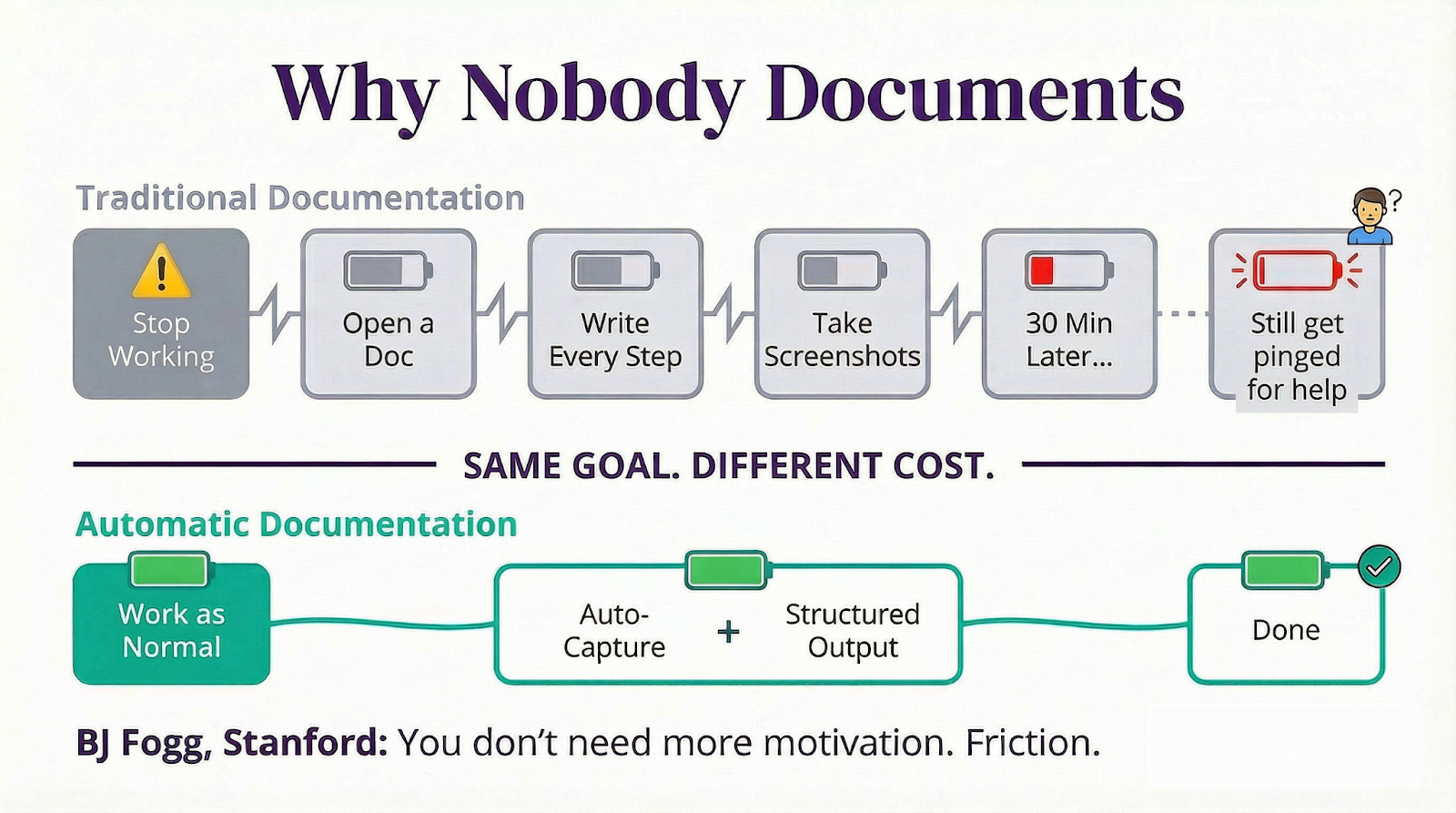
We've been doing documentation for 5+ years at Tango and we've learned many truths. The first is that most companies haven't even started documenting because of how hard it is. For any expert it requires stopping what you're doing, opening a page, writing out every step, taking screenshots. By the time you're done you've lost 30 minutes. And oh yeah, it might change next week. So you just... don't. "Ping me if you need help."
Many companies have responded to this by forcing their employee base to take action. Or hiring for it and managing to it. Even grading job performance on it. But deciding carrot or stick isn't actually the main difference maker in sparking true behavior change. Stanford researcher BJ Fogg figured out in 2007 that you might not need more motivation, you might just need less friction. People want to do it, it's just actually too hard. That's why Tango can make a major difference in your AI efforts. You want something that everyone can use and that makes it dead-simple to record clicks and context. Something that packages knowledge intuitively and beautifully to make knowledge owners proud and eager to do more. And critically, something that captures knowledge in a way that serves both humans and agents.
The Compounding Risk of Imperfection → What Happens When the Docs Are 85% Right
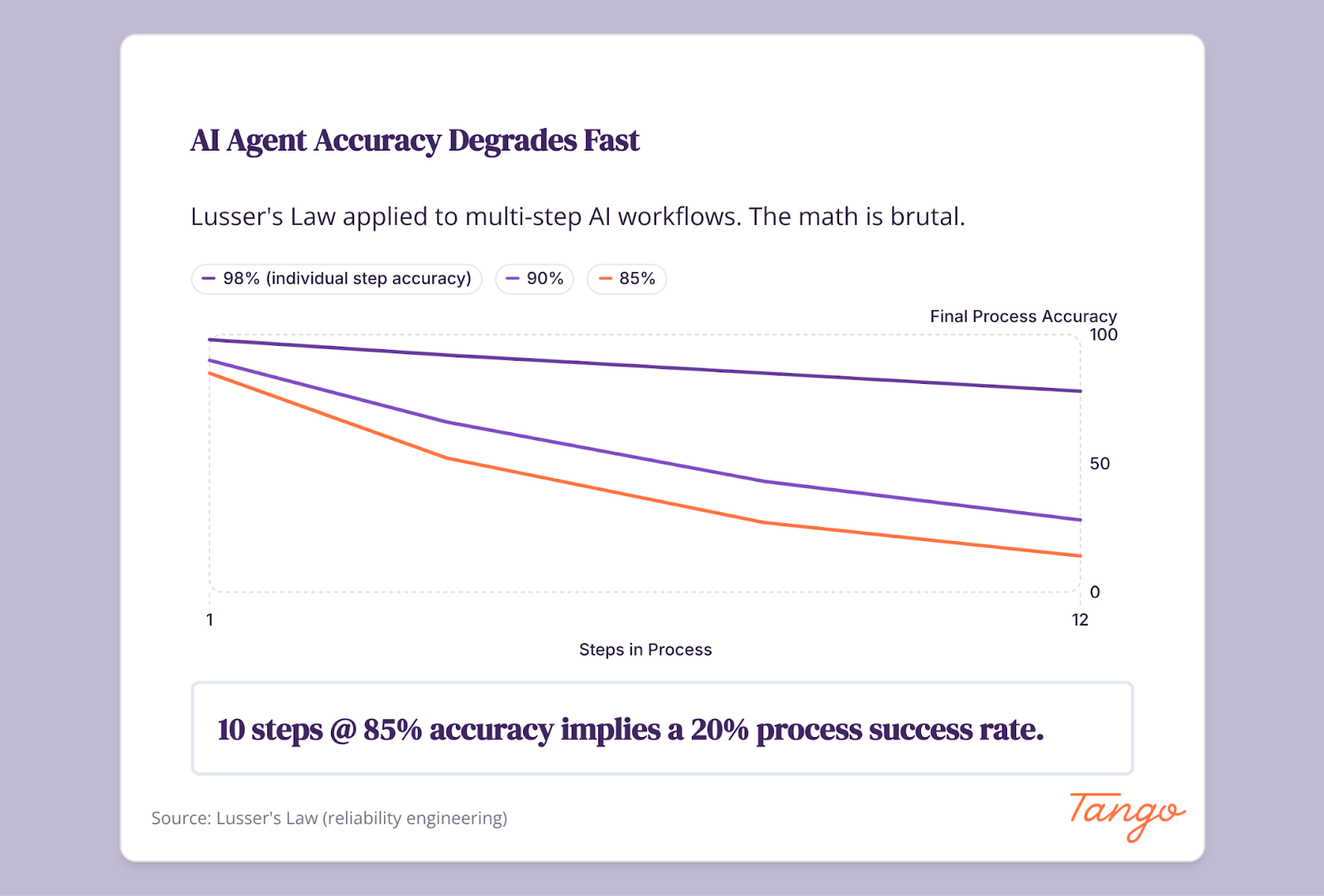
If getting started is hard, it may be disheartening to realize that having the high-level process jotted out isn't enough. Actually just doing that would be a huge gamble. How accurate and how thorough your documentation is determines how far an agent can go before it breaks or worse, makes errors and continues. There's a principle in reliability engineering called Lusser's Law that makes this concrete.
Lusser's Law states that the reliability of a sequential system is the product of each step's reliability. Basically, each step in a workflow multiplies against the others, so small gaps compound fast.
An AI agent at 85% accuracy per step on a 10-step workflow succeeds only ~20% of the time.
Think about what that means for a real workflow example. A RevOps team processing a new enterprise deal might touch Salesforce, CPQ, DocuSign, Slack, the billing system, the provisioning tool, and the CS onboarding platform. 7+ handoffs. At 85% per step, the agent gets the whole chain right 1 out of every 5 times. That's the current state of attempting an AI-powered deal desk.
So you have to get every click and API call extremely accurate. But you also need to get the edge cases. Escalation triggers. Dependencies. The mini-decision points laced throughout a complex procedure. During early deployments, this is what agents are struggling with most. And is also what's hard to get on paper, often buried deeply in the team's expertise and instincts and only situationally apparent.
The aggregate data suggests these exact problems will keep rearing their head for companies who try to jump the gun on AI projects without preparation. Gartner projects that companies will cancel 40%+ of agentic AI projects by the end of 2027. MIT Technology Review found only 1 in 10 companies have scaled agents beyond a pilot.
But the success stories are real too.
In 2024, Klarna, a Swedish FinTech company, famously built AI assistants that were wired with the company's complete customer service documentation and had stunning results. 7 specialized agents were each given structured documentation about coverage rules and fraud patterns and handled 2.3 million conversations in the first month, overall completing the work of 700 human agents and cutting processing time by 80%.
Let's break down how you can do it too.
A 3-Step Framework for Getting AI-Ready with Docs
AI is still a rather new and daunting topic but context-building - documentation - doesn't need to be:
Step 1: Start documenting (so you can use AI later). To begin, you need to build and share a belief with others that AI is here to help. It will help the company win and it will help everyone in their careers. And that documenting will help them take advantage of it and later on work with it. You need to create a purpose and a means for people to capture what they actually do. It's critical that this isn't just a few people who raise their hand but it's every single person in every function. Step 1 will not only lay groundwork for each process but it will also help your team or org identify where the biggest opportunities are to start exposing real workflow logic to agents.
Step 2: Optimize and standardize. Working with customers on their documentation efforts at Tango, we'll often see that companies using Tango across their entire orgs are dumbfounded when they see the number of ways that things are actually happening. You might discover your customer onboarding process had 4 variations across 4 CSMs, none matching the "official" playbook in Confluence. While process drift may be scary, it's also a remarkable way to innovate and standardize new best paths. Individuals at the edge can be quite creative and in this way, documentation work also naturally becomes process improvement work - critical for a future where efficiency and token scarcity will be real constraints.
Step 3: Enrich with context and scenarios. This is what will likely be beyond what you've ever done before in the documentation realm. Once you have docs, you'll need the constraints, edge cases, and judgment calls that took your team years to learn. Consider that docs have historically been reference material for new hires, complemented by ramp periods and manager + peer support. But docs are getting a new job for AI. They need to be a reliable, structured knowledge layer that agents can depend on: how work flows through an organization and all the pathways it could take. This means people will need to care for their processes and docs like they never have before. They need to explain process variations and voiceover watchouts and validation criteria. As if they were giving the most detailed training session of their careers to a prodigiously bright intern.
You'll realize that documentation work compounds. Each round of documentation deepens your understanding of a process, which surfaces more opportunities to improve it, which generates better documentation.
The benefit for your team is that this will be the core practice and mental model to improve AI, a skill that will be invaluable for their career and your organization for years to come.
Sharpening your toolset: There won't be a single way to interface with and "instruct" agentic systems. In fact, there will surely be many ways as the human-agent paradigm proliferates. We just advise you set out to do it in a way where humans can easily and willingly share their knowledge. And one where the structure that Agents need will be automatically captured. For example, Tango's process recorder captures deep step-specific context and meta-data that can easily be translated into Agent Skills. Videos can work as well but you risk incurring a massive amount of reasoning cost later. And they're hard to later add context to (Step 3).
The day your org deploys AI agents: The day will come soon when you're ready to experiment more with agents. While you'll inevitably always be continuing process definition work, you'll want to come out of the gates with a few high-frequency, high-value, workflows that have been thoroughly documented over weeks or months.
A Worthy Investment
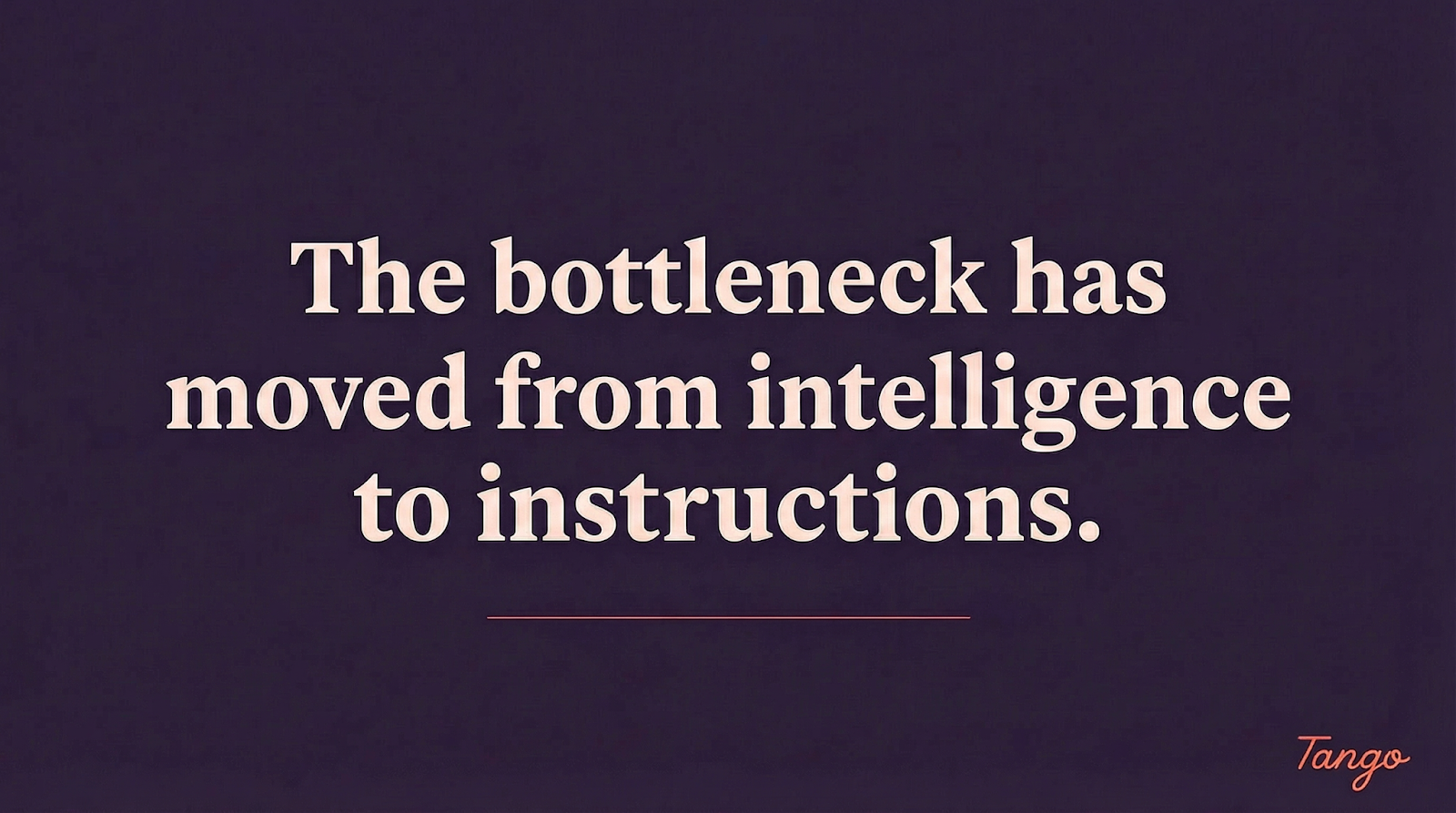
When it comes to technology claims and predictions it's hard to know what to believe in the news and on social platforms these days. But in the midst of all the noise, it does increasingly feel like we're at the inflection point. Specifically a new chapter in AI adoption where the bottleneck has moved from intelligence to instructions and where our creations and systems are really as powerful as we set out to make them.
Compiling your hard-earned context system, your unique competitive advantage that's gotten you this far, will perhaps be the greatest business investment you can make. Organizations that not only know how their work gets done, but can articulate it in structured, clear, accessible form, will deploy AI faster, cheaper, and with fewer failures. That's true today. It'll be true in 5 years. The companies that skip the documentation work risk finding themselves ill-equipped to deal with an uncertain future. Start telling what you know. Start building the instructions. "Excellence," the great football coach Vince Lombardi said, "is achieved by mastering the fundamentals.”
The bottom line
Keep in touch
We'll never show up empty-handed (how rude!).
Thank you! Your submission has been received!
Oops! Something went wrong while submitting the form.