Employee Training Methods Your Team Will Love (Part 3 of 4)

So far, we’ve covered eight different training methods in parts one and two of this series—and we’ve still got eight more to go. 😁 Today we’re exploring these four:
Role-playing
Role-playing isn't just for Dungeons & Dragons. It's a type of simulation training where teammates can practice solution scenarios that involve different types of people. 🎭
For example, you can take on different personas to see how your team handles tough customers. How will they react to tough feedback or long lists of questions? You can do these in person or incorporate questions like these into other workplace training techniques (during a coaching session, for example).
As far as benefits go, you’ll get to see how your team may react in tough situations. Role-playing can also help your team practice thinking on their toes and testing out different responses before experiencing the real thing.
That said, it’s important to note role-playing can’t prepare teams for everything or accurately predict how people will react in the moment. Some may panic or react differently when faced with an upset customer. Or the opposite may be true. What they do while role-playing may feel off if they’re uncomfortable or just aren’t a fan of this training method.
Also good to consider: Doing this training method in person can take an especially long time if you have a big group, and if you’re giving everyone a chance to practice individually.
Spaced learning
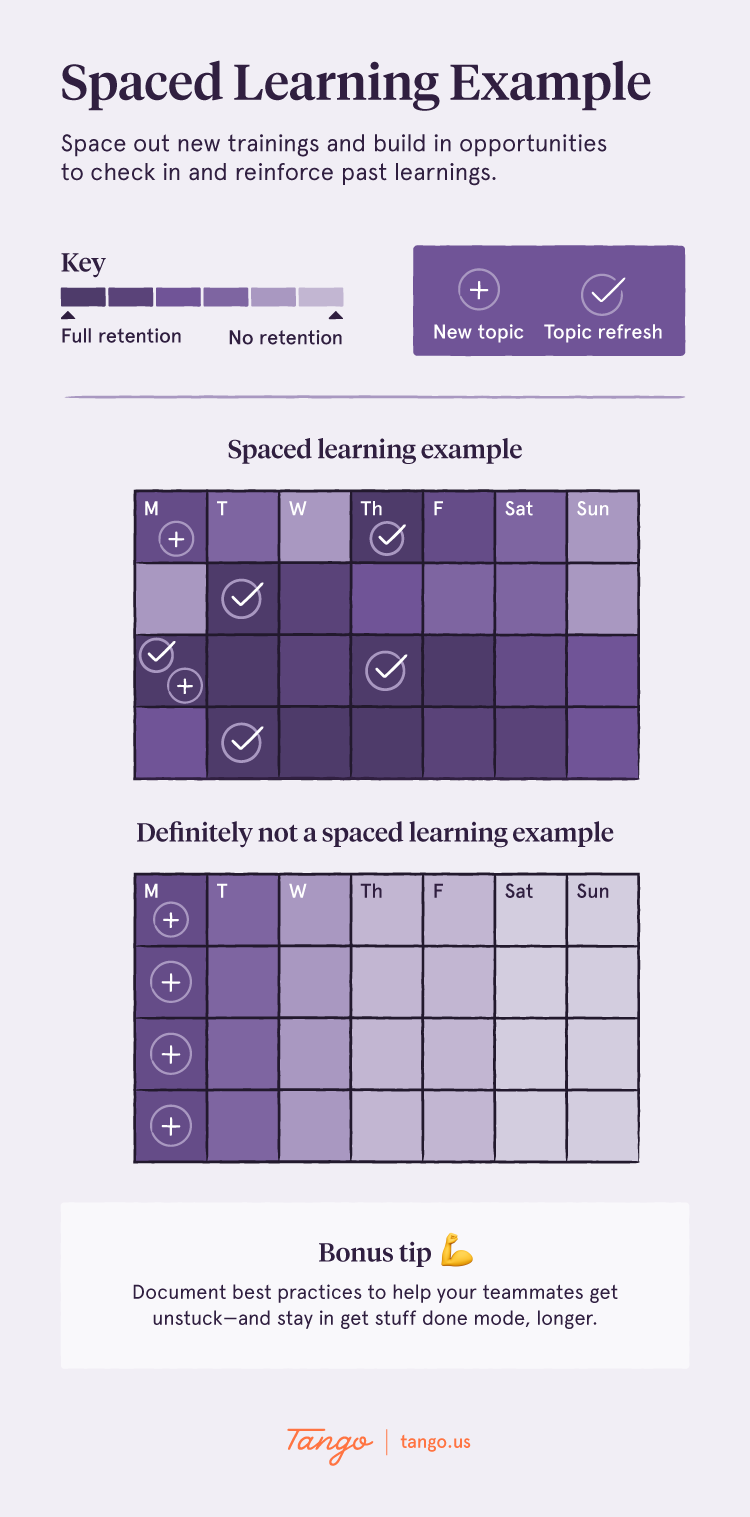
Spaced learning is exactly as it sounds—spaced out periods of learning (with ongoing reinforcement).
It’s a good solution for a very human problem: We forget things! Especially after a couple of hours of back-to-back training sessions. Since this method spaces out training periods, your team can find a better balance between training and work.
More importantly, spaced learning helps improve retention with check-ins and reinforcement. Check-ins can be as simple as sending out a reminder or as elaborate as a new quiz in your e-learning program.
The problem? Spaced learning isn’t for everyone or every topic. Some teammates can quickly grasp the subject and may not need to spend time on constant reinforcement. Some topics may not need this many revisits. It can also extend training or team ramp timelines and requires more time from trainers.
Job shadowing
Job shadowing is when one teammate follows another teammate to get a first-hand look at a role or specific task. This employee training method is useful if you have teammates who are:
- Interested in moving into another role or department
- Eager to learn about tasks and responsibilities before their next promotion
- Struggling with a task and can learn from seeing a top performer’s process
This approach brings a lot more real-world exposure than they’d get from instructor-lead classes or other types of structured learning. It also gives your team a chance to network and learn from different perspectives.
Shadow sessions don’t need to last all day. You can squeeze them in when it works best for everyone’s schedule. You can even set up a shadow during a couple of meetings or while someone is working through a project.
That said—job shadowing has its limits. It’s not always easy to find volunteers since it requires a major commitment, especially on busy days.
The experience can also vary for shadowers. Since every day is different, one teammate may have a more fulfilling experience than another. The shadow session also may not cover everything they wanted to learn about.
Coaching and mentoring
Coaching and mentoring programs pair your top performers (or an outside expert) with other teammates who can benefit from their expertise. The goals of the program can dictate the structure:
- If your teammate needs help improving performance → Assign them a coach with a structured coaching plan
- If a teammate is coming back from parental leave → Assign them a coach with a return-to-work transition plan
- If your teammate wants to learn more about growing at the company → Assign them a mentor with periodic coffee chats
- If your teammate is new → Assign them a mentor with a list of suggested new hire mentee-mentor conversation topics
These programs can give mentees a casual environment to ask questions and learn about their mentor’s experiences. Great mentors and coaches can also help them build confidence in their abilities. 🙌
Other benefits: Your junior teammates can get one-on-one attention and tailored help, your senior teammates can flex their leadership skills, and you get a chance to capture your team’s institutional knowledge in the process. The program can also spark new friendships or a long-term mentorship.
However, just like job shadowing, this employee training method requires commitment from coaches and mentors who may be pressed for time. You could find yourself with a shortage of mentors and coaches—and a long list of excited mentees.
A lack of structure can also lead to vastly different outcomes or show favoritism. Some may love their mentor, while others may barely meet. Some may also prefer a teammate who seems similar to them (called affinity bias), but letting mentors (or mentees) choose their pairing may not be the most effective method.
FAQ



Next time someone asks, “how do I…?” Send a Tango.
Start capturing your first workflow today.