Process Documentation Part 1: Tips & Tricks from a People Ops Pro


With a decade of experience in HR operations and executive administration, Jordyn Rarick knows a lot about employee lifecycle and process building. She joined us for a process documentation strategy workshop to share everything she’s learned by leading People Operations at Marqeta (check it out below! ⬇️).
Running low on time? Here’s part one of Jordyn’s playbook, complete with the resources referenced throughout the recording.
Setting the stage: Documentation then vs. now
Process documentation may have a bunch of benefits, but what about the drawbacks?
Documentation to date
Historically, creating any kind of documentation has been:
- Tedious. Explaining how to do stuff in software—in excruciating detail—and using Snagit to take 50+ screenshots isn’t the most exciting work in the world.😴
- Time-consuming. Taking hours to document a single process feels like a wasted effort because it’ll sit in your knowledge base where no one can find it. ⏳
- Thankless. After all that (manual) effort, your documentation hardly ever gets used or appreciated like it should. 😤
Consuming documentation has also been equally frustrating, because it’s usually:
- Hard to find. Weeding through long videos, training recordings, email threads, outdated wikis, and disorganized knowledge bases wastes time (and forces employees to bother their coworkers with repeated questions). 🔍
- Hard to trust. How can someone know if the documentation is out of date? 🤔
- Hard to apply. Traditional documentation typically isn’t delivered in the context of a real-world task (which doesn’t make it very actionable). 🆘
- Hard to retain. Remembering what to do is hard enough, remembering where to look for it is even harder. 🤷
- Hard to love. ICYMI, here’s the truth about training guides. 🫣
Process documentation as a blueprint for business success
To Jordyn, documenting processes is foundational to scalable and sustainable business growth. Here are six of the biggest benefits she saw in her own role at Marqeta (with actionable guidance for you):
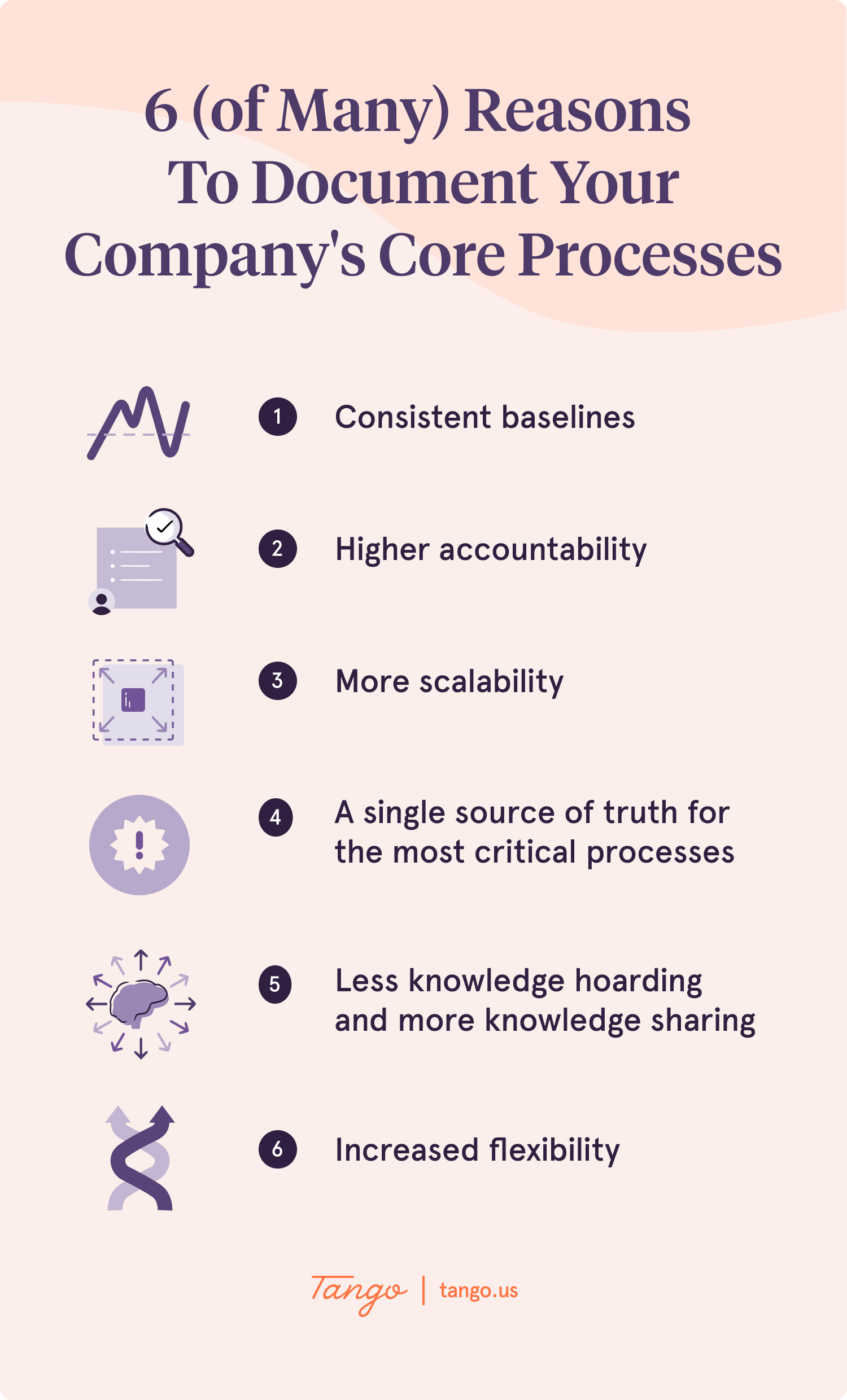
1. Consistent baselines
If your company has 20 different people completing a process in 20 different ways, it’s hard to know where to even begin. Here’s how you can start:
☐ Document the “default” version first: Identify the most common or lowest-risk way the process is currently completed and document that as your baseline—even if it’s not perfect yet.
☐ Standardize inputs and outputs: Clearly define what triggers the process, what tools are used, and what a “done” state looks like so everyone is working toward the same outcome.
☐ Schedule quarterly reviews: Assign a recurring check-in to validate whether the documented baseline still reflects reality and update it as needed.
"You can't build on something without a foundation."
-Jordyn Rarick, People Operations Coordinator at Marqeta
2. Higher accountability
When knowledge lives exclusively in the heads of a few top performers, it’s easy for others to miss critical steps within a workflow, take shortcuts, and pass the buck for mistakes made.
Without knowing who’s responsible for what, it’s nearly impossible to understand all the major players, wrap your head around end-to-end processes as they exist today, and figure out 1) what needs to be created, and 2) what can be optimized.
☐ Assign owners at the step level: Document not just what happens, but who is responsible for each step (owner, contributor, approver).
☐ Clarify handoffs: Explicitly note where responsibility transfers between roles or teams to reduce confusion and dropped work.
☐ Map gaps and overlaps: Use the documented process to identify unclear ownership or duplicated effort—and resolve it intentionally.
3. More scalability
If you work in HR/People Operations, your ability to make an impact is directly tied to your ability to 1) drive efficient growth and 2) adapt to inevitable changes.
Process documentation gives you a starting point for deploying solutions at scale—and increasing your company’s capacity for more strategic work. (Not to mention your own!)
☐ Document before automating: Capture the current-state process before introducing new tools or workflows to avoid scaling inefficiencies.
☐ Design with growth in mind: Add notes for volume thresholds (e.g., “This breaks at 200 employees”) to flag when a process needs rework.
☐ Create templates for reuse: Turn repeatable workflows into templates that can be easily cloned across teams, regions, or programs.
4. A single source of truth for the most critical processes
Without (consolidated) process documentation, it’s easy for FAQs and expert insights to live all over the place. Over time, the information people need to do their jobs and companies need to thrive gets lost in people’s desktop folders, online drives, Slack threads, email chains, etc.
☐ Choose one official home: Designate a single system or workspace as the authoritative source and make it clear that outdated docs live elsewhere.
☐ Link, don’t duplicate: Replace copies with links to the source doc to prevent version sprawl.
☐ Add context at the top: Include a short “When to use this” and “Last updated” section so readers can quickly assess relevance and freshness.
5. Less knowledge hoarding and more knowledge sharing
Institutional knowledge is invaluable, especially when it comes to the more nuanced tips and tricks subject matter experts (SMEs) tend to accumulate over time.
Say your SMEs *aren’t* disciplined about capturing how key processes should be done, and at some point, they get new jobs. When they leave, all the things that only they know how to do will leave with them.
Needless to say…it’s pretty tough to scale expertise without the people who have it.
☐ Capture SME insights explicitly: Add a section for tips and edge cases so nuanced expertise doesn’t get lost.
☐ Build documentation into offboarding: Make process handoff and validation a required step when someone changes roles or leaves.
☐ Rotate reviewers: Have non-SMEs periodically test the process to ensure it’s understandable without tribal knowledge.
6. Increased flexibility
Jordyn couldn’t stress the importance of this one enough—especially for companies with remote or flex-first work policies.
If you document your processes, what becomes a lot less friction-filled? Collaborating with teammates in different geographies and time zones.
☐ Write for async execution: Document decisions, dependencies, and escalation paths so work can move forward without live clarification.
☐ Time-zone proof your processes: Note expected response times instead of specific hours, and flag steps that require real-time collaboration.
☐ Enable self-serve onboarding: Use documented processes to help new hires ramp independently—no calendar coordination required.
Process documentation is a big unlock for businesses—especially high-growth, work-from-anywhere companies that need to be nimble to be competitive.
Put process documentation into action
Convinced to start building your own documentation strategy? Check out part two of our recap of Jordyn’s webinar for a three-pronged approach (plus templates!).



Next time someone asks, “how do I…?” Send a Tango.
Start capturing your first workflow today.